
A Complete Guide to Clear Aligners in Kochi & Ernakulam
Looking for Invisalign treatment in Kochi, Ernakulam or Kerala? Clear aligner treatment has become an increasingly popular orthodontic option for people who want to straighten their teeth without the appearance of conventional metal braces.
Unlike traditional braces, clear aligners are removable, transparent orthodontic appliances that are designed to gradually move teeth according to a customized treatment plan. Invisalign® is one of the best-known clear aligner systems and uses a sequence of customized aligners under the supervision of a dentist or orthodontist. Most Invisalign patients are instructed to wear their aligners for approximately 20 to 22 hours a day for the planned tooth movements to occur.
However, clear aligner treatment is not simply a matter of ordering transparent trays. The diagnosis, orthodontic treatment planning, selection of appropriate tooth movements, monitoring, patient compliance and retention are all important parts of successful treatment.
At Nikhil Dental Clinic, Vyttila, Kochi, Invisalign and aligner treatment is provided with orthodontic evaluation by Dr. Smrithi Soman, Specialist Orthodontist and Aligner Expert.
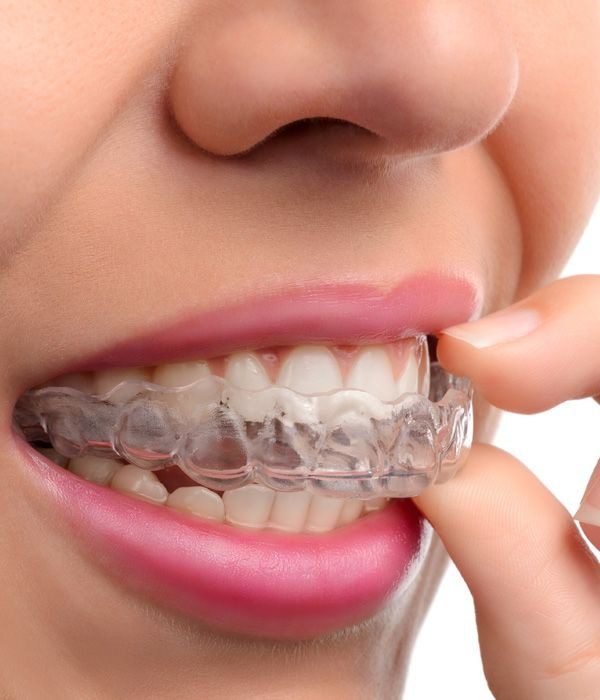
Invisalign Treatment in Kochi: Why Professional Orthodontic Assessment Matters
Clear aligners are designed to produce controlled tooth movement. The aligner itself provides force to the teeth, but the treatment outcome depends heavily on how the case is diagnosed and planned.
Research indicates that clear aligners are particularly useful for selected mild-to-moderate orthodontic problems, while some complex movements and severe malocclusions may require additional orthodontic mechanics or conventional fixed appliances.
Therefore, the important question is not simply:
“Can Invisalign straighten my teeth?”
The better question is:
“Is clear aligner treatment appropriate for my particular teeth, bite, gums, bone support and orthodontic requirements?”
That determination should be made after a clinical examination by an orthodontist.
Meet the Orthodontist at Nikhil Dental Clinic, Vyttila
Dr. Smrithi Soman
Specialist Orthodontist & Aligner Expert
Dr. Smrithi Soman is an orthodontist providing orthodontic and aligner-based treatment at Nikhil Dental Clinic, Vyttila, Kochi.
Educational qualifications
- Bachelor of Dental Surgery (BDS) from Manipal College of Dental Sciences
- Master of Dental Surgery (MDS) in Orthodontics and Dentofacial Orthopaedics from SDM College of Dental Sciences, Dharwad, Karnataka
- 5 years of expertise in dentistry
- Available full-time at Nikhil Dental Clinic, Vyttila
Her orthodontic training is particularly relevant when assessing whether a patient is suitable for clear aligners, braces, or a combination of orthodontic approaches.
What Is Invisalign Treatment?
Invisalign is a brand of clear aligner orthodontic treatment.
Instead of brackets and wires being attached to the teeth, Invisalign treatment uses a sequence of customized transparent aligners. Each aligner is designed to produce specific tooth movements, and the patient progresses through the sequence according to the orthodontist’s treatment plan.
The basic principle is:
Diagnosis → Digital planning → Customized aligners → Gradual tooth movement → Refinement → Retention
Invisalign describes its treatment process as beginning with an assessment and digital scan, followed by computerized treatment planning and a sequence of customized aligners. Regular clinical appointments are used to monitor progress.
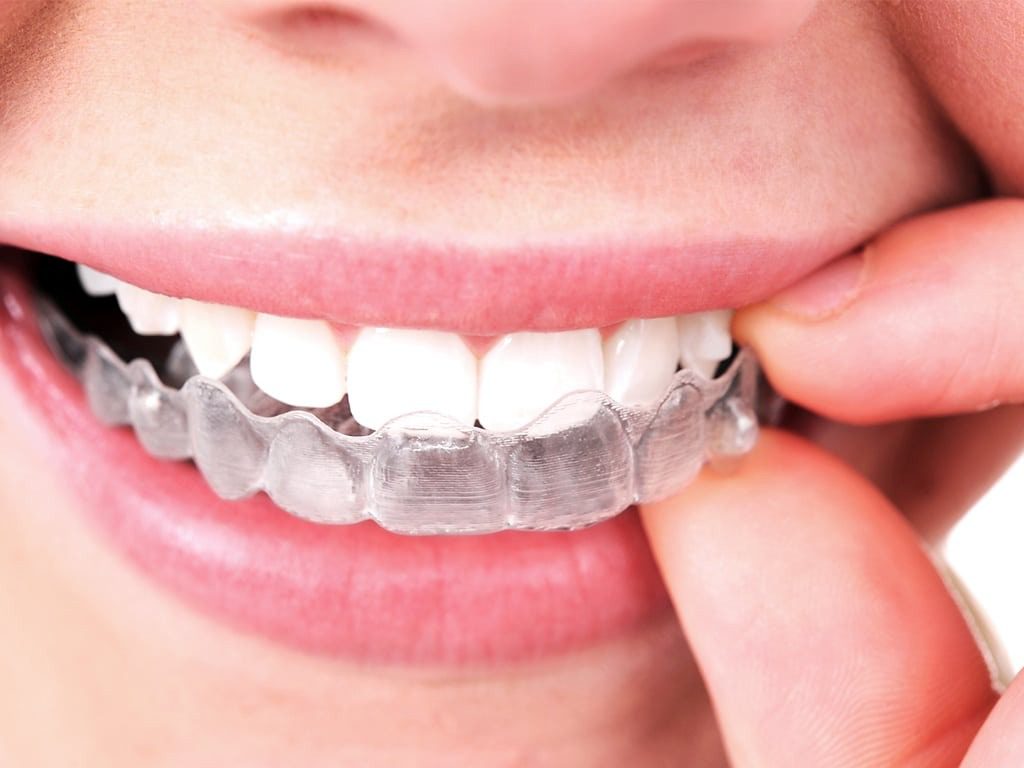
How Do Invisalign Clear Aligners Move Teeth?
Teeth are not fixed permanently inside the jawbone. They are supported by periodontal tissues and bone that can remodel in response to controlled orthodontic forces.
An aligner fits over the teeth and applies carefully planned forces. With each stage, selected teeth are encouraged to move toward their planned positions.
A complete treatment plan may involve movements such as:
- Rotation
- Tipping
- Alignment
- Leveling
- Space closure
- Limited expansion
- Correction of certain bite problems
- Controlled intrusion or extrusion
- Coordination of the upper and lower dental arches
The ability to achieve each movement varies according to the tooth, direction of movement, available space, root position, bone support and complexity of the case.
This is one reason why an orthodontic assessment is essential.
Recent research continues to show that clear aligner predictability varies according to the type of tooth movement and complexity of the malocclusion.
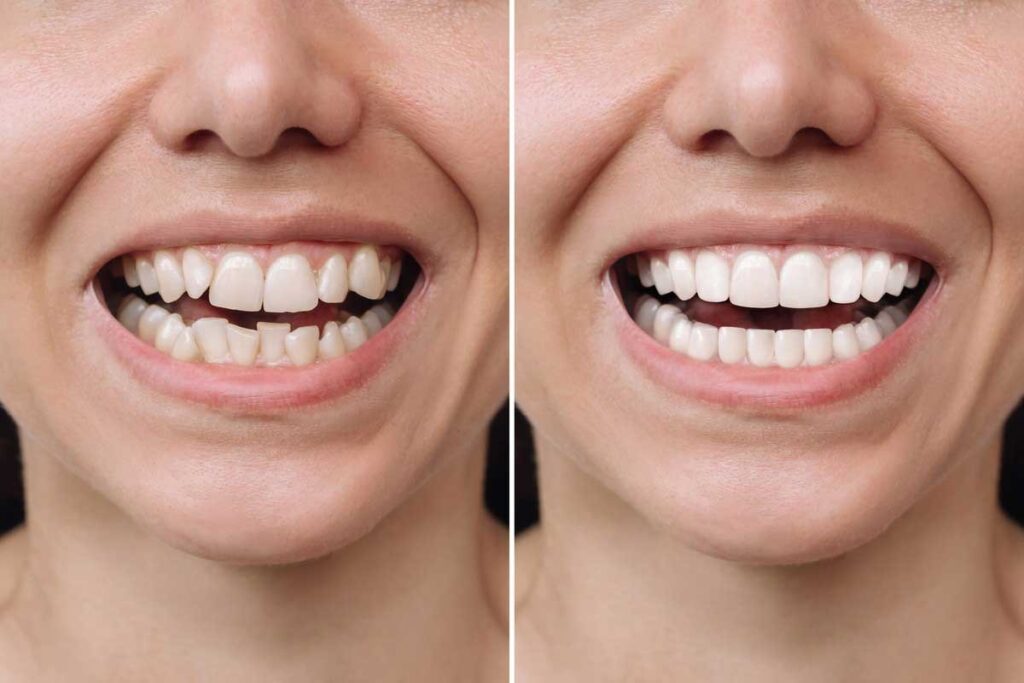
Who May Be Suitable for Invisalign Treatment?
Clear aligners may be considered for patients with problems such as:
- Crowded teeth
When there is insufficient space in the dental arch, teeth may overlap or appear rotated.
Depending on the severity, orthodontic treatment may create space through controlled arch development, tooth movement, enamel reduction between selected teeth, or other planned methods.
- Gaps between teeth
Clear aligners can be used to close certain spaces between teeth.
- Mild to moderate crooked teeth
Patients with mild or moderate tooth misalignment may be good candidates for clear aligner treatment.
- Relapse after previous braces
Some adults who previously completed orthodontic treatment may experience tooth movement over time.
For selected relapse cases, clear aligners may be considered to realign the teeth.
- Certain bite problems
Depending on the diagnosis, clear aligners may be used to manage selected cases involving:
- Overbite
- Open bite
- Crossbite
- Certain Class II problems
- Mild spacing
- Mild-to-moderate crowding
However, the suitability of aligners depends on the individual orthodontic diagnosis rather than simply the presence of a particular bite problem.
Who May Not Be an Ideal Candidate?
Clear aligners are not automatically appropriate for every patient.
Some cases can be challenging because they require precise control of:
- Severe rotations
- Significant vertical movements
- Large tooth movements
- Complex extraction spaces
- Severe skeletal discrepancies
- Impacted teeth
- Major jaw discrepancies
- Complex root movements
- Severe periodontal problems
Research reviews have found that clear aligners can be effective for selected cases, particularly mild-to-moderate malocclusions, but may have limitations with certain complex movements and severe cases.
A 2026 review also highlighted continuing limitations in the predictability of some clear-aligner tooth movements and emphasized the importance of case selection, overcorrection and, in complex situations, possible hybrid treatment or conversion to fixed appliances.
This does not mean that a complex case can never be treated with aligners. It means the treatment approach should be selected based on the individual diagnosis.
Who May Not Be an Ideal Candidate?
Clear aligners are not automatically appropriate for every patient.
Some cases can be challenging because they require precise control of:
- Severe rotations
- Significant vertical movements
- Large tooth movements
- Complex extraction spaces
- Severe skeletal discrepancies
- Impacted teeth
- Major jaw discrepancies
- Complex root movements
- Severe periodontal problems
Research reviews have found that clear aligners can be effective for selected cases, particularly mild-to-moderate malocclusions, but may have limitations with certain complex movements and severe cases.
A 2026 review also highlighted continuing limitations in the predictability of some clear-aligner tooth movements and emphasized the importance of case selection, overcorrection and, in complex situations, possible hybrid treatment or conversion to fixed appliances.
This does not mean that a complex case can never be treated with aligners. It means the treatment approach should be selected based on the individual diagnosis.
Invisalign Treatment Process: Step-by-Step
Stage 1: Initial Orthodontic Consultation
Your treatment starts with a consultation.
The orthodontist evaluates:
- Facial profile
- Smile
- Teeth alignment
- Bite
- Crowding
- Spacing
- Jaw relationship
- Gum health
- Existing dental restorations
- Previous orthodontic treatment
- Oral hygiene
- Functional concerns
Your dental and medical history may also be relevant.
The orthodontist then determines whether clear aligners are suitable.
Stage 2: Diagnostic Records
Depending on the case, diagnostic records may include:
- Digital intraoral scan
- Photographs
- Dental examination
- Dental X-rays
- Panoramic radiograph
- Lateral cephalometric radiograph
- Other imaging when clinically indicated
The purpose is not simply to create attractive digital images.
The orthodontist needs to understand what is happening above the gum, below the gum and within the supporting bone before deciding how teeth should move.
Stage 3: Digital 3D Scan
Modern clear aligner treatment can use digital scanning instead of traditional impression materials.
A digital scanner captures a three-dimensional representation of the teeth.
The digital records can then be used to develop a computerized orthodontic treatment plan.
In Invisalign treatment, digital records are incorporated into treatment planning using Invisalign’s digital workflow and ClinCheck® software.
Stage 4: Treatment Planning
This is one of the most important stages.
The orthodontist determines:
- Which teeth need to move
- Which teeth should remain stable
- How much movement is appropriate
- Whether space needs to be created
- Whether attachments are required
- Whether IPR is required
- Whether elastics or additional orthodontic mechanics are required
- The sequence of tooth movements
- The approximate treatment duration
- The expected final bite
The computer simulation helps visualize the proposed tooth movement, but the digital plan should not replace clinical judgment.
The orthodontist remains responsible for determining whether the proposed movement is appropriate for the patient.
Stage 5: Digital Treatment Simulation
A digital simulation can show how the teeth are expected to move throughout treatment.
Patients may be able to see:
Current alignment → Intermediate stages → Proposed final alignment
This can help patients understand the treatment process before beginning.
However, a digital simulation is a treatment plan, not a guarantee of the final clinical result.
Actual tooth movement can differ from the computer prediction. Research has documented discrepancies between planned and achieved movements, particularly for some more demanding movements.
Stage 6: Receiving Your First Aligners
Once the treatment plan is finalized and the aligners are fabricated, the patient receives the first series of aligners.
The orthodontist checks:
- Fit
- Seating
- Comfort
- Attachment engagement where applicable
- Patient understanding
- Insertion and removal technique
- Cleaning instructions
- Wearing schedule
Patients are generally instructed to wear Invisalign aligners for approximately 20 to 22 hours per day, removing them primarily for eating, drinking beverages other than water and oral hygiene.
Stage 7: Wearing Each Aligner
Each aligner represents a stage in the treatment sequence.
As you progress through the aligners, the teeth gradually move.
Your orthodontist will tell you exactly when to change aligners.
Do not independently change the schedule simply because a new aligner feels comfortable.
The prescribed schedule should be followed because the sequence is designed around planned tooth movement.
Stage 8: Attachments
One common misconception is that Invisalign always means completely invisible treatment.
Not necessarily.
Some patients require small tooth-coloured attachments.
What are Invisalign attachments?
Attachments are small, tooth-coloured shapes bonded temporarily to selected teeth.
They help the aligner grip and control certain movements.
They can assist with movements that would be difficult to achieve with the aligner alone.
Invisalign describes SmartForce® attachments as small tooth-coloured shapes bonded to teeth to assist with planned tooth movements.
Depending on your case, you may have:
- Few attachments
- Several attachments
- Attachments on front teeth
- Attachments on posterior teeth
The number and position depend entirely on the treatment plan.
Stage 9: IPR or Interproximal Reduction
Some patients may require interproximal reduction (IPR).
IPR involves carefully reducing a very small amount of enamel between selected teeth to create space.
It may be considered when the orthodontist needs additional space for alignment.
IPR is not required for every Invisalign patient.
If required, the orthodontist determines:
- Which teeth require IPR
- How much space is required
- At what stage it should be performed
The procedure should be planned carefully and performed using appropriate clinical techniques.
Stage 10: Progress Monitoring
Clear aligner treatment still requires professional supervision.
At review appointments, the orthodontist evaluates:
- Tooth movement
- Aligner fit
- Bite
- Oral hygiene
- Attachment condition
- Patient compliance
- Tracking of teeth
- Any discomfort or problems
If the teeth are not tracking according to plan, the orthodontist may modify the treatment strategy.
Stage 11: Refinement Aligners
Many patients assume the first series of aligners must produce the final result.
That is not always the case.
Sometimes additional aligners are required to make final corrections.
These are commonly called refinement aligners or additional aligners.
Refinement may be required if:
- A tooth has not moved as predicted
- Minor rotations remain
- Small spaces remain
- Bite requires further adjustment
- Additional detailing is needed
Refinements are particularly relevant in more complex cases. Invisalign itself describes additional aligner sets as a normal part of complex treatment planning.
Stage 12: Completion of Active Treatment
Once the orthodontist is satisfied with:
- Tooth alignment
- Bite
- Tooth contacts
- Smile appearance
- Functional relationship
the active aligner phase can be completed.
Attachments, if used, are removed.
A final scan or dental records may be taken for retention.
Stage 13: Retainers
This stage is often underestimated.
Straightening your teeth is only half the orthodontic journey. Keeping them straight is the long-term responsibility.
After orthodontic treatment, teeth naturally have a tendency to shift.
Retainers help maintain the corrected positions.
Types of retainers may include:
- Clear removable retainers
- Hawley retainers
- Fixed/bonded retainers
- Other customized retention appliances
The appropriate type and wearing schedule depend on the patient’s orthodontic condition.
Retention is an important part of orthodontic treatment because teeth can shift after active treatment.
How Long Does Invisalign Treatment Take?
There is no single treatment duration that applies to everyone.
Treatment time depends on:
- Severity of crowding
- Amount of spacing
- Type of bite problem
- Number of teeth requiring movement
- Required tooth movements
- Whether extractions are necessary
- Patient age and growth status
- Periodontal condition
- Compliance
- Aligner tracking
- Refinements
- Additional orthodontic procedures
Some relatively minor cases may be completed in a shorter period, while comprehensive cases may require considerably longer treatment.
The Invisalign system itself notes that treatment duration depends on case complexity and daily wear compliance.
Scientific evidence also does not support a universal claim that clear aligners are always faster than braces. A systematic review found no significant difference in treatment duration for mild-to-moderate crowding cases, while another recent meta-analysis found treatment quality and duration vary according to case type and complexity.
Therefore, an orthodontist should provide a personalized estimated timeline rather than promising a fixed number of months.
How Many Hours a Day Should Invisalign Be Worn?
For Invisalign treatment, patients are generally advised to wear their aligners for approximately:
20–22 hours per day
The aligners are normally removed for:
- Eating
- Drinking beverages other than water
- Brushing
- Flossing
- Cleaning the aligners
The removable nature of aligners is one of their major advantages, but it also creates an important responsibility.
With braces, the appliance remains attached to your teeth.
With clear aligners, the patient controls how long the appliance is actually being worn.
Poor compliance can therefore affect treatment progress.
Can You Eat Normally During Invisalign Treatment?
One advantage of removable aligners is that they can generally be removed while eating.
You can therefore maintain a much more normal diet compared with many patients wearing fixed braces.
However:
- Remove the aligners before eating.
- Avoid wearing them while chewing food.
- Clean your teeth before putting them back in whenever possible.
- Keep the aligners clean.
- Follow your orthodontist’s specific instructions.
The Invisalign manufacturer recommends removing aligners for eating and drinking anything other than water.
Can You Drink Tea or Coffee With Invisalign?
It is generally advisable to remove clear aligners before consuming hot, coloured or sugary beverages.
For example:
- Tea
- Coffee
- Soft drinks
- Fruit juices
- Coloured beverages
Water is generally the simplest beverage to consume while wearing aligners.
This helps reduce the risk of staining and allows better oral hygiene.
Is Invisalign Painful?
Invisalign treatment can cause temporary pressure or mild discomfort, particularly when starting a new aligner.
This happens because the aligner is applying force to the teeth.
Patients may notice:
- Tightness
- Pressure
- Mild tenderness
- Temporary sensitivity
Discomfort varies between individuals.
Invisalign reports that initial tightness or discomfort is commonly temporary, although patients should contact their orthodontist if they experience significant or persistent problems.
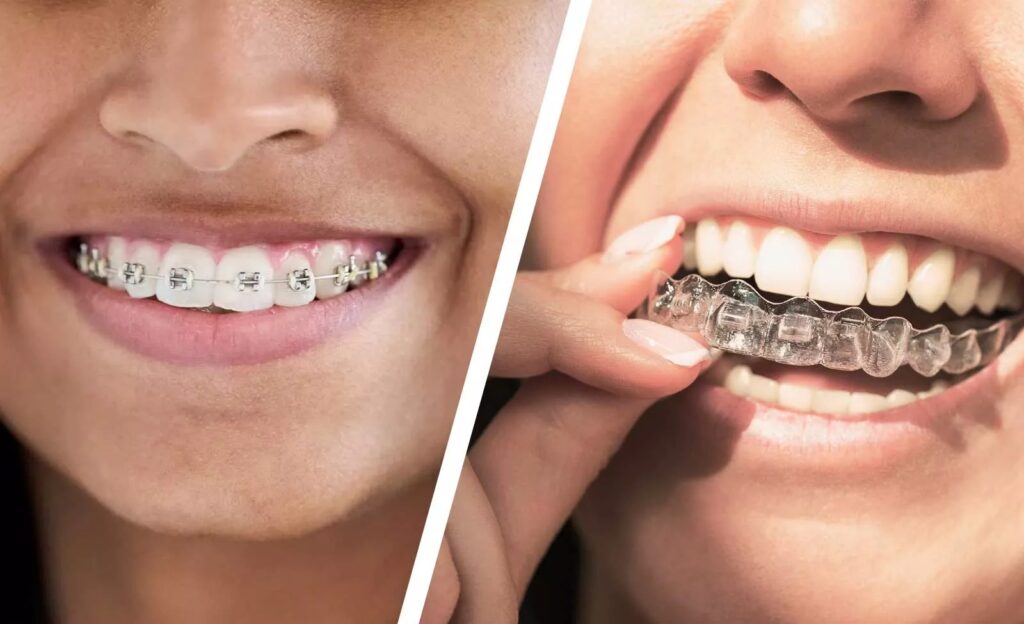
Invisalign vs Traditional Braces
Feature | Invisalign / Clear Aligners | Traditional Braces |
Appearance | Transparent/discreet | More visible |
Removable | Yes | No |
Eating | Aligners removed before eating | Dietary precautions may be required |
Oral hygiene | Easier appliance removal | Requires cleaning around brackets/wires |
Compliance | Highly important | Appliance remains fixed |
Complex movements | Case-dependent | Often strong control for complex movements |
Attachments | May be required | Brackets and wires provide control |
Refinements | May be required | Adjustments are performed during treatment |
Retention | Required | Required |
Suitability | Depends on diagnosis | Depends on diagnosis |
Neither appliance should automatically be considered appropriate for every patient.
Recent systematic reviews emphasize that case complexity and the specific tooth movements required should influence appliance selection.
Advantages of Invisalign Treatment
For suitable patients, clear aligners can offer several practical advantages.
Discreet appearance
The transparent design makes aligners less noticeable than conventional metal braces.
Removable
You can remove the aligners for meals and oral hygiene.
Easier access for brushing
Because the appliance is removable, patients can brush and floss without brackets and wires covering the teeth.
Fewer dietary restrictions
You generally remove the aligners before eating.
Convenient for professional and social situations
Adults may prefer a less visible orthodontic appliance for work, meetings and social events.
Digital treatment planning
Modern aligner treatment incorporates digital scanning and computer-assisted treatment planning.
Limitations of Invisalign Treatment
Clear aligners are not perfect.
Potential limitations include:
- Compliance is essential
Wearing aligners inconsistently can interfere with treatment progress.
- Some movements are difficult
Certain rotations, vertical movements, root movements and complex bite corrections can be less predictable.
- Attachments may be required
Although aligners themselves are clear, some cases need tooth-coloured attachments.
- Refinements may be needed
The initial series may not always produce every planned movement.
- Complex cases may need additional mechanics
Some patients may benefit from braces, elastics or a hybrid orthodontic approach.
- Treatment is not completely passive
Regular orthodontic reviews remain important.
Clinical evidence continues to show limitations in certain complex cases, including extraction-based treatment and precise root control.
Invisalign for Adults in Kochi
Adults frequently consider clear aligners because orthodontic treatment can be integrated into professional and social life with less visible hardware.
Common reasons adults seek treatment include:
- Crowded front teeth
- Spaces between teeth
- Teeth that shifted after previous braces
- Cosmetic concerns
- Bite problems
- Preparing for cosmetic dental treatment
- Improving alignment before restorative treatment
Age alone does not automatically determine whether someone can have aligner treatment.
The more important questions are:
Are the teeth and supporting tissues healthy?
What orthodontic movement is required?
Can the patient comply with the wearing schedule?
Is the case suitable for clear aligners?
These questions should be answered during an orthodontic examination.
Invisalign for Teenagers
Clear aligners may also be used for selected teenagers.
However, compliance becomes especially important because the appliance is removable.
Parents and teenagers should understand:
- Required daily wear
- Cleaning
- Safe storage
- Aligner changes
- Review appointments
- Lost aligner procedures
- Retainer use after treatment
Invisalign has developed treatment options for younger patients, but individual suitability still needs to be determined clinically.
Invisalign for Crowded Teeth
Crowding is one of the common reasons patients seek orthodontic treatment.
Depending on its severity, the orthodontist may create space using:
- Controlled tooth movement
- Arch development
- Interproximal reduction
- Distal movement in selected cases
- Extraction in selected complex cases
The correct approach depends on the patient’s facial profile, periodontal condition, tooth size, jaw relationship and amount of crowding.
This is why simply looking at photographs is not enough to prescribe treatment.
Invisalign for Gaps Between Teeth
Clear aligners can be used to close selected spaces.
However, the orthodontist must determine why the space exists.
Possible contributing factors include:
- Tooth size discrepancies
- Missing teeth
- Previous tooth loss
- Gum-related problems
- Tongue habits
- Tooth position
- Jaw relationships
Closing a gap without addressing its cause can increase the risk of recurrence.
Invisalign for Relapsed Orthodontic Treatment
Some people who had braces during childhood or adolescence notice their teeth becoming crooked again years later.
This is called orthodontic relapse.
For suitable cases with relatively limited tooth movement required, clear aligners can be considered.
However, the orthodontist should evaluate the current bite and tooth position rather than simply reproducing the original treatment.
After correction, long-term retention becomes particularly important.
Does Invisalign Work for Severe Dental Problems?
This requires careful assessment.
Modern clear aligner systems can address a broader range of orthodontic conditions than early generations of aligners.
However, evidence still indicates limitations in some severe or complex cases. Complex extraction cases, major skeletal discrepancies, severe impactions and some demanding tooth movements may require conventional braces, additional mechanics or a combined treatment approach.
Therefore:
Do not choose Invisalign simply because it is more aesthetic. Choose the orthodontic treatment that can safely achieve the required tooth and bite correction.
How Much Does Invisalign Cost in Kochi?
There is no responsible single price that can be applied to every patient.
The cost can vary depending on:
- Complexity of the case
- Number of aligners
- Treatment duration
- Type of Invisalign treatment
- Need for attachments
- IPR
- Additional aligners/refinements
- X-rays and diagnostic records
- Retainers
- Other dental treatment required before orthodontics
Invisalign’s published information also states that treatment cost varies according to factors such as case complexity, location and provider.
At Nikhil Dental Clinic, patients can discuss the treatment plan and associated costs during their orthodontic consultation.
What Should You Ask Before Starting Invisalign?
Before beginning treatment, ask your orthodontist:
- Am I suitable for clear aligners?
- What type of bite problem do I have?
- How much crowding or spacing do I have?
- Will I need IPR?
- Will I need attachments?
- Will extractions be necessary?
- How many aligners are expected?
- How long is the estimated treatment?
- Could I need refinement aligners?
- How often will I need appointments?
- What happens if an aligner is lost?
- What happens if a tooth does not track?
- What type of retainer will I need?
- How long will I need to wear retainers?
- What is included in the total treatment cost?
These questions can help patients make an informed decision instead of choosing treatment solely based on appearance or advertised treatment duration.
Caring for Invisalign Aligners
Good aligner hygiene is important.
Basic care routine
Morning
- Remove aligners
- Brush teeth
- Clean aligners
- Rinse before reinserting
After meals
- Remove aligners
- Eat
- Brush and/or rinse appropriately
- Clean the aligners
- Reinsert them
At night
- Brush and floss
- Clean aligners
- Wear them while sleeping
Always follow the cleaning instructions provided by your orthodontist and the aligner manufacturer.
What Happens If You Lose an Aligner?
Do not simply skip ahead to the next aligner without professional advice.
Contact your orthodontic clinic.
Depending on how long you have been wearing the lost aligner and the stage of treatment, the orthodontist may advise:
- Wearing the previous aligner
- Moving to the next aligner
- Replacing the lost aligner
- Re-scanning
- Making another clinical adjustment
The correct response depends on the individual treatment plan.
What Happens If My Aligner Does Not Fit Properly?
An aligner that suddenly does not seat correctly may indicate that the teeth are not tracking as expected.
Possible reasons include:
- Insufficient wear
- Incorrect aligner insertion
- Missed aligner changes
- Tooth movement not progressing as planned
- Damaged aligner
- Attachment problem
Do not force the aligner.
Contact your orthodontist so the problem can be assessed.
Can Invisalign Fix Teeth Without Braces?
For suitable cases, yes.
Clear aligners are themselves an orthodontic appliance and can move teeth without conventional brackets and wires.
However, the appropriate appliance depends on the diagnosis.
Some cases are better managed using:
- Clear aligners
- Fixed braces
- Ceramic braces
- Hybrid treatment
- Aligners plus elastics
- Other orthodontic mechanics
The objective should be the appropriate orthodontic correction, not simply avoiding braces at all costs.
Why Choosing an Orthodontist Matters
Orthodontics is more than straightening visible teeth.
A comprehensive orthodontic assessment considers:
Teeth + roots + bone + gums + bite + jaw relationship + facial aesthetics + long-term stability
An orthodontist trained in orthodontics and dentofacial orthopaedics is specifically trained to diagnose and manage malocclusion and tooth-position problems.
For patients considering Invisalign in Kochi or Ernakulam, choosing a clinician who can evaluate both simple and complex orthodontic problems can be important when deciding whether aligners are appropriate.
Invisalign Treatment at Nikhil Dental Clinic, Vyttila, Kochi
Nikhil Dental Clinic is located at:
Kavalampillil Lane, Paradise Road, Janatha, Vyttila, Kochi, Kerala – 682019
The clinic has been serving patients since 1996.
The clinic provides dental and orthodontic care, including assessment for patients considering clear aligner treatment.
For patients from Vyttila, Ernakulam, Kochi and surrounding areas, the location provides access to orthodontic consultation with:
Dr. Smrithi Soman
MDS Orthodontics & Dentofacial Orthopaedics
Qualifications:
- BDS – Manipal College of Dental Sciences
- MDS – Orthodontics and Dentofacial Orthopaedics, SDM College of Dental Sciences, Dharwad
- 5 years of expertise in dentistry
- Full-time availability at Nikhil Dental Clinic, Vyttila
The clinic’s current listed location is Kavalampillil Lane, Paradise Road, Janatha, Vyttila, Kochi, Kerala 682019.
Why Patients From Ernakulam Can Consider Vyttila for Orthodontic Consultation
Vyttila is a centrally connected part of Kochi and is convenient for patients travelling from several areas of Ernakulam.
Patients considering orthodontic treatment can schedule an assessment to determine:
- Whether they are suitable for Invisalign
- Whether braces would be more appropriate
- The expected treatment duration
- Whether attachments are required
- Whether IPR is necessary
- Whether extractions are required
- The estimated treatment cost
- The expected retention protocol
A consultation is the appropriate starting point because treatment requirements vary significantly from one patient to another.
Frequently Asked Questions About Invisalign in Kochi
- What is Invisalign?
Invisalign is a branded clear aligner orthodontic system that uses a sequence of customized removable aligners to gradually move teeth. The treatment is planned and monitored by a dental professional or orthodontist.
- Is Invisalign better than braces?
There is no universally better option.
Clear aligners can offer aesthetic and removable advantages, while fixed appliances may provide advantages for certain complex tooth movements. The appropriate option depends on the patient’s diagnosis and treatment objectives.
- How many hours should I wear Invisalign?
Most Invisalign patients are advised to wear their aligners for approximately 20–22 hours per day.
- Can I remove Invisalign while eating?
Yes. Invisalign aligners are designed to be removable, and they should generally be removed while eating.
- Can I drink coffee while wearing Invisalign?
It is generally better to remove the aligners when drinking coffee, tea and other beverages besides water, particularly because coloured or hot drinks can stain or affect the appliance.
- Does Invisalign hurt?
You may experience temporary pressure or mild discomfort when beginning a new aligner. Significant or persistent pain should be discussed with your orthodontist.
- How long does Invisalign treatment take?
Treatment duration varies according to case complexity, required tooth movements and patient compliance. A personalized estimate should be provided after orthodontic examination and treatment planning.
- Can Invisalign fix crowded teeth?
Yes, clear aligners can treat many cases of crowding. The orthodontist determines whether the crowding is mild, moderate or severe and decides how the required space should be created.
- Can Invisalign close gaps?
Yes, selected spacing cases can be treated using clear aligners. The cause and size of the spaces must first be evaluated.
- Do I need attachments with Invisalign?
Not everyone needs attachments. Some patients require small tooth-coloured attachments to help achieve specific tooth movements.
- What is IPR in Invisalign treatment?
IPR stands for interproximal reduction. It involves carefully reducing a small amount of enamel between selected teeth to create space when clinically indicated.
- Can Invisalign treat an overbite?
Selected overbite cases can be treated with clear aligners, but the severity and underlying cause matter. The orthodontist must assess the bite before recommending aligners.
- Can Invisalign treat an underbite?
Some underbite cases may be managed with clear aligners, while more severe skeletal discrepancies may require different orthodontic or orthognathic treatment.
- Can Invisalign treat an open bite?
Selected open-bite cases can be treated with aligners, but the underlying cause and severity are important factors.
- Can Invisalign treat severe crowding?
Some severe crowding cases may be treated using advanced aligner protocols, but conventional braces or additional orthodontic procedures may be more appropriate depending on the diagnosis.
- Will I need braces if Invisalign does not work as planned?
Not necessarily, but in complex cases additional orthodontic mechanics or a change in appliance may sometimes be necessary. Recent evidence emphasizes that treatment predictability varies with case complexity and tooth movement.
- Are Invisalign aligners completely invisible?
They are transparent and designed to be discreet, but attachments may be visible on some teeth depending on the treatment plan.
- Can adults get Invisalign?
Yes. Adults are commonly treated with clear aligners when they are suitable candidates.
- Can teenagers get Invisalign?
Clear aligner treatment can be used for selected teenagers. The orthodontist must assess the individual’s dental development, orthodontic problem and ability to comply with wear requirements.
- Can I sleep with Invisalign?
Yes. Sleeping while wearing the aligners is part of the prescribed daily wear schedule.
- What happens after Invisalign treatment?
You will normally enter the retention phase. Retainers are used to help maintain the new tooth positions and reduce the risk of relapse.
- Do I need retainers forever?
Long-term retention is generally an important part of orthodontic care because teeth can move over time. Your orthodontist will determine the appropriate retainer type and wearing schedule for your case.
- Is Invisalign expensive in Kochi?
The cost varies depending on case complexity, treatment requirements, duration and other clinical factors. An exact cost should be provided after assessment rather than based on a generic online price.
- How do I know whether Invisalign is suitable for me?
The best way is to undergo an orthodontic consultation. Your orthodontist can examine your teeth and bite, review diagnostic records and determine whether clear aligners, braces or another approach is appropriate.
- Where can I consult an orthodontist for Invisalign in Kochi?
Patients looking for Invisalign or clear aligner consultation in Kochi can consult Dr. Smrithi Soman, MDS Orthodontics and Dentofacial Orthopaedics, at Nikhil Dental Clinic, Vyttila, Kochi.
Final Takeaway: Is Invisalign Right for You?
Clear aligners have changed the way many patients approach orthodontic treatment.
They can provide a discreet and removable alternative to conventional braces for appropriately selected cases. However, Invisalign should not be treated as a universal solution for every orthodontic problem.
The most important factors are:
Accurate diagnosis
Appropriate case selection
Experienced orthodontic treatment planning
Good patient compliance
Regular monitoring
Refinement when required
Long-term retention
Current research supports clear aligners for many selected orthodontic cases but also shows that treatment predictability varies according to case complexity and the type of tooth movement required.
If you are considering Invisalign treatment in Kochi, Ernakulam or elsewhere in Kerala, the first step should be an orthodontic consultation rather than choosing an appliance based only on advertisements, price or computer-generated before-and-after images.
At Nikhil Dental Clinic, Vyttila, patients can consult Dr. Smrithi Soman, MDS Orthodontics and Dentofacial Orthopaedics, for an individualized assessment of their alignment and bite and to discuss whether clear aligner treatment is appropriate.
Nikhil Dental Clinic
Address: Kavalampillil Lane, Paradise Rd, Janatha, Vyttila, Kochi, Kerala – 682019
Orthodontist: Dr. Smrithi Soman, MDS Orthodontics & Dentofacial Orthopaedics
Specialization: Orthodontics and Clear Aligner Treatment
Availability: Full-time at Nikhil Dental Clinic, Vyttila
Serving: Vyttila, Kochi, Ernakulam and surrounding areas