
Best Invisalign Treatment in Kochi (2026 Guide): Cost, Procedure, Benefits, Before & After, FAQs and Everything You Need to Know
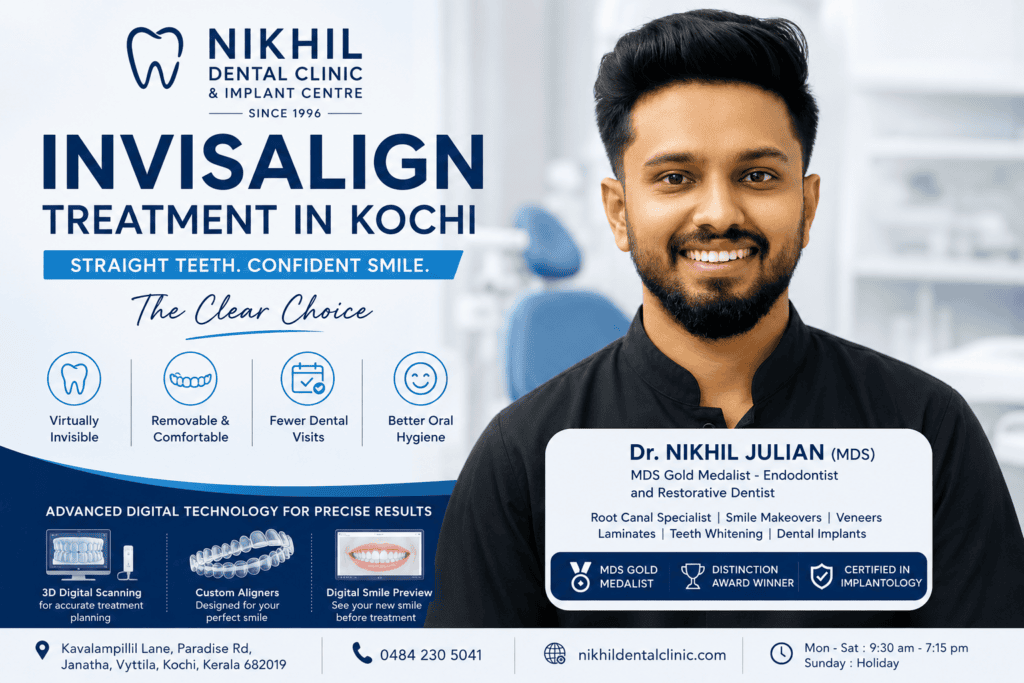
Dr. Nikhil Julian
July 30, 2026
Published: July 2026
Last Updated: July 2026
Reading Time: 25 Minutes
Medically Reviewed by
Dr. Nikhil Julian, BDS, MDS (Gold Medalist)
Endodontist & Restorative Dentist
- MDS (Gold Medalist) in Conservative Dentistry & Endodontics
- Certified in Clinical Implantology
- Smile Makeover Expert
- Cosmetic Dentistry
- Restorative Dentistry
- Dental Veneers & Laminates
- Teeth Whitening
Invisalign Treatment in Kochi
Looking for the best Invisalign treatment in Kochi? Whether you’re a working professional, student, entrepreneur, bride-to-be, or simply someone who wants a straighter smile without the appearance of traditional braces, Invisalign has become one of the most sought-after orthodontic solutions in Kerala.
Unlike conventional braces with metal brackets and wires, Invisalign uses a series of clear, removable aligners that gradually reposition your teeth according to a digitally planned treatment pathway. The aligners are virtually invisible, comfortable to wear, and designed to fit into everyday life with minimal disruption.
At Nikhil Dental Clinic, Vyttila, Kochi (Since 1996), we believe every smile is unique. Our approach begins with a comprehensive dental evaluation to understand your oral health, smile goals, bite relationship, and treatment options. Patients receive clear guidance so they can make informed decisions about their dental care.
If you have been searching online for:
- Invisalign Kochi
- Invisalign Treatment Kochi
- Best Invisalign Clinic Kochi
- Invisalign Cost Kochi
- Invisible Braces Kochi
- Clear Aligners Kochi
- Teeth Aligners Kochi
- Invisalign Kerala
- Invisalign Near Me
this comprehensive guide answers virtually every question patients commonly ask before starting treatment.
Table of Contents
- What is Invisalign?
- Why Invisalign is Popular in Kochi
- How Invisalign Works
- Conditions Invisalign Can Treat
- Invisalign vs Traditional Braces
- Invisalign vs Generic Clear Aligners
- Step-by-Step Invisalign Treatment Process
- Digital Smile Planning
- Benefits of Invisalign
- Invisalign Cost in Kochi
- Treatment Duration
- Eating with Invisalign
- Cleaning Your Aligners
- Life During Treatment
- Possible Limitations
- Why Choose Nikhil Dental Clinic
- About Dr. Nikhil Julian
- Frequently Asked Questions
What is Invisalign?
Invisalign is one of the world’s most advanced clear aligner systems designed to straighten teeth without traditional metal braces.
Instead of brackets and wires, Invisalign uses custom-manufactured transparent aligners that gently guide teeth into their desired positions through carefully planned, incremental movements.
Every aligner is individually designed using advanced three-dimensional digital technology. Patients wear each aligner for approximately one to two weeks before progressing to the next set, allowing gradual and predictable tooth movement.
Unlike removable retainers that simply maintain tooth position, Invisalign aligners are engineered to actively move teeth according to a personalised treatment plan developed after a detailed dental assessment.
Millions of patients worldwide have chosen Invisalign because it offers a combination of aesthetics, comfort, convenience, and precision.
Why More People in Kochi Are Choosing Invisalign
In recent years, Invisalign has become increasingly popular among patients across Kochi, Ernakulam, Kakkanad, Vyttila, Edappally, Palarivattom, Kaloor, Panampilly Nagar, Thrippunithura, Aluva, and surrounding areas.
Several factors contribute to this growing demand:
Virtually Invisible Appearance
Many adults delay orthodontic treatment because they are concerned about wearing visible braces. Invisalign aligners are transparent, making them a discreet option for everyday life.
Suitable for Professional Life
Professionals who regularly interact with clients or colleagues often appreciate the subtle appearance of clear aligners during meetings, presentations, and video calls.
Comfortable Daily Wear
The smooth plastic design reduces the irritation commonly associated with metal brackets and wires.
Freedom to Eat
Because aligners are removable, patients can continue enjoying their favourite foods without the dietary restrictions commonly associated with traditional braces.
Better Oral Hygiene
Brushing and flossing remain straightforward because the aligners can be removed before cleaning your teeth.
Understanding How Invisalign Works
One of the biggest advantages of Invisalign is that treatment begins with careful planning rather than guesswork.
Every stage is digitally mapped before the first aligner is worn.
Step 1: Initial Consultation
The first appointment includes a comprehensive dental examination.
Your dentist evaluates:
- Tooth alignment
- Bite relationship
- Jaw function
- Existing restorations
- Gum health
- Bone support
- Oral hygiene
- Smile aesthetics
Clinical photographs, X-rays, and digital scans may also be recommended to build a complete understanding of your oral health.
Step 2: Digital 3D Scanning
Traditional impression materials are increasingly being replaced by advanced intraoral scanners that capture highly detailed digital images of your teeth.
These images create an accurate three-dimensional model of your mouth, providing greater precision during treatment planning.
Step 3: Personalised Digital Treatment Planning
Using specialised orthodontic software, each planned tooth movement is mapped from start to finish.
Patients may be able to preview their expected smile transformation before treatment begins, helping them better understand the planned outcome.
Step 4: Manufacturing Your Custom Aligners
A series of individually customised aligners is fabricated specifically for your treatment plan.
Each aligner moves selected teeth by a small amount, gradually achieving the desired alignment over time.
Step 5: Wearing the Aligners
For optimal results, aligners are typically worn for 20 to 22 hours each day.
They should generally be removed only for:
- Meals
- Snacks
- Brushing
- Flossing
- Drinking beverages other than water
Consistent wear is one of the most important factors influencing treatment success.
Step 6: Progress Reviews
Periodic review appointments allow your dental team to monitor progress and ensure treatment is proceeding according to the planned movements.
Where necessary, refinements or adjustments may be recommended to achieve the best possible outcome.
What Dental Problems Can Invisalign Treat?
Invisalign may be suitable for correcting a wide range of orthodontic concerns, depending on the individual case.
These include:
Crowded Teeth
When teeth overlap because there is insufficient space within the dental arch, cleaning becomes more difficult and plaque accumulation may increase.
Gaps Between Teeth
Spaces between teeth can affect both appearance and function.
Overbite
Excessive overlap of the upper front teeth over the lower teeth.
Underbite
Lower front teeth extend beyond the upper front teeth.
Crossbite
Some upper teeth bite inside the lower teeth rather than outside.
Open Bite
Front teeth fail to meet when the mouth is closed.
Mild Relapse After Previous Braces
Patients who have experienced shifting after earlier orthodontic treatment may also benefit from clear aligner therapy.
The most appropriate treatment depends on a detailed clinical assessment. Some complex orthodontic conditions may require alternative approaches or additional procedures.
Invisalign vs Traditional Braces
Choosing between Invisalign and traditional braces depends on your dental condition, lifestyle, and treatment goals.
| Feature | Invisalign | Traditional Braces |
|---|---|---|
| Appearance | Virtually invisible | Metal brackets visible |
| Comfort | Smooth aligners | Brackets and wires may cause irritation |
| Eating | Remove before meals | Food restrictions apply |
| Oral Hygiene | Easy to brush and floss | Cleaning requires extra care |
| Emergencies | No broken wires | Wire or bracket issues may occur |
| Follow-up Visits | Generally fewer emergency visits | Adjustments required periodically |
| Removable | Yes | No |
Both treatment methods have advantages, and the most suitable option should be determined after a professional evaluation.
Invisalign vs Generic Clear Aligners
Not all clear aligners are the same.
Patients often confuse Invisalign with generic aligner systems available in the market.
Important differences may include:
- Digital planning technology
- Material quality
- Precision of tooth movement
- Clinical research
- Global treatment experience
- Professional supervision
- Long-term outcome predictability
Patients should always discuss available treatment options with their dentist to understand which solution is most appropriate for their specific needs.
Benefits of Invisalign
Patients often choose Invisalign because it offers multiple practical and aesthetic advantages.
Nearly Invisible
Most people will not notice you are wearing aligners.
Comfortable
The aligners are made from smooth medical-grade plastic without metal brackets or wires.
Removable
Patients can remove aligners while eating, brushing, and flossing.
Better Oral Hygiene
Since the aligners are removable, maintaining daily oral hygiene is generally easier than with fixed braces.
Digital Treatment Planning
Treatment follows a personalised digital plan developed before therapy begins.
Improved Confidence
Many patients appreciate the ability to smile naturally throughout treatment without feeling self-conscious about metal braces.
Why Proper Diagnosis Matters
Although Invisalign is an advanced treatment option, successful results depend on careful diagnosis and treatment planning.
A comprehensive assessment helps identify:
- Existing dental restorations
- Gum disease
- Tooth wear
- Bite irregularities
- Jaw function
- Bone support
- Oral hygiene needs
Addressing these factors before orthodontic treatment contributes to better long-term oral health and more predictable outcomes.
Invisalign Cost in Kochi, Treatment Timeline, Attachments, IPR, Retainers, Before & After, Risks, Why Choose Nikhil Dental Clinic & Conclusion
How Much Does Invisalign Cost in Kochi?
One of the first questions patients ask is:
“What is the cost of Invisalign treatment in Kochi?”
The answer depends on several clinical factors because every smile is unique. Invisalign treatment is customised according to the complexity of tooth movement, treatment duration, and the number of aligners required.
Factors That Influence Invisalign Cost
The total treatment fee may vary depending on:
- Severity of crowding or spacing
- Bite correction requirements
- Number of aligners needed
- Treatment duration
- Complexity of tooth movements
- Need for attachments or refinements
- Whether additional dental procedures are required before treatment
- Retainers after completion
A personalised consultation, digital assessment, and treatment plan are the most reliable way to receive an accurate estimate.
Important: Choosing Invisalign based only on the lowest price may not provide the best long-term outcome. The experience of the treating clinician, quality of diagnosis, careful treatment planning, and follow-up care are all important considerations.
Is Invisalign Worth the Investment?
For many patients, Invisalign is not simply a cosmetic treatment. Properly aligned teeth can contribute to:
- Easier cleaning between teeth
- Better oral hygiene
- Reduced plaque accumulation in crowded areas
- Improved chewing efficiency
- Enhanced smile confidence
- Greater comfort during daily activities
The long-term value lies in both functional improvement and aesthetic enhancement.
How Long Does Invisalign Treatment Take?
Treatment duration varies depending on the complexity of the case and patient compliance.
Mild Cases
Approximately 6 to 9 months
Examples include:
- Minor spacing
- Mild crowding
- Small orthodontic corrections
Moderate Cases
Approximately 12 to 18 months
Commonly includes:
- Moderate crowding
- Bite correction
- Multiple tooth movements
Complex Cases
More extensive orthodontic corrections may require 18 to 24 months or longer, depending on the diagnosis and treatment goals.
Does Invisalign Hurt?
One of the biggest misconceptions is that Invisalign treatment is painful.
Most patients describe the feeling as mild pressure rather than pain, especially during the first one or two days after switching to a new aligner.
This pressure indicates that controlled forces are moving the teeth gradually according to the treatment plan.
Any discomfort is usually temporary and tends to decrease as the teeth adapt.
How Many Hours Should Invisalign Be Worn?
For predictable results, Invisalign aligners are generally worn for:
20 to 22 hours every day
Patients should remove the aligners only while:
- Eating
- Drinking beverages other than water
- Brushing
- Flossing
Inconsistent wear may prolong treatment or reduce the effectiveness of planned tooth movements.
Can You Eat Normally with Invisalign?
Yes.
One of the greatest advantages of Invisalign is that patients remove the aligners before meals.
Unlike traditional braces, there are no permanent dietary restrictions.
You can continue enjoying:
- Kerala meals
- Rice
- Fish
- Chicken
- Biryani
- Fruits
- Nuts
- Corn
- Popcorn
- Chapati
- Dosa
- Appam
After eating, brush your teeth before reinserting the aligners whenever possible.
Can You Drink Coffee or Tea?
Hot beverages should not be consumed while wearing Invisalign aligners because heat may affect the material.
Coffee, tea, coloured soft drinks, and juices can also stain the aligners.
The recommended approach is to:
- Remove the aligners
- Enjoy your beverage
- Rinse if needed
- Brush when possible
- Reinsert the aligners
Plain water is generally safe while wearing aligners.
Maintaining Good Oral Hygiene During Invisalign Treatment
Maintaining oral hygiene is an essential part of successful treatment.
Patients are encouraged to:
- Brush after every meal
- Floss daily
- Clean aligners regularly
- Rinse aligners with lukewarm water
- Avoid abrasive toothpaste on aligners
- Store aligners safely when removed
Healthy gums and clean teeth contribute to better treatment outcomes.
What Are Invisalign Attachments?
During treatment, some patients require small tooth-coloured composite attachments.
These tiny attachments act as grip points that help the aligners apply controlled forces for more complex tooth movements.
Attachments are:
- Tooth coloured
- Small
- Comfortable
- Removed after treatment
Not every Invisalign case requires attachments.
What is IPR (Interproximal Reduction)?
Some patients may hear the term IPR during treatment planning.
IPR refers to the controlled removal of a very small amount of enamel between selected teeth to create additional space for tooth movement.
When indicated, IPR is:
- Carefully planned
- Minimally invasive
- Performed conservatively
- Based on clinical judgement
Not all patients require IPR.
What Are Invisalign Refinements?
Occasionally, after completing the initial series of aligners, additional aligners may be recommended to further improve the final result.
These are known as refinements.
Refinements help optimise tooth position and smile aesthetics when clinically appropriate.
What Happens After Invisalign Treatment?
Finishing treatment is not the end of your smile journey.
Teeth naturally have a tendency to shift over time.
To maintain the achieved alignment, retainers are usually recommended.
Why Are Retainers Important?
Retainers help maintain the corrected tooth position after active orthodontic treatment.
Failure to wear retainers as instructed may result in gradual tooth movement or relapse.
Your dentist will recommend the most appropriate retainer type and wearing schedule based on your individual needs.
Invisalign Before and After: What Can Patients Expect?
Every patient begins treatment with a unique smile, bite, and orthodontic concern.
The expected outcome depends on several factors, including:
- Initial tooth alignment
- Bite relationship
- Bone support
- Gum health
- Patient compliance
- Treatment objectives
Many patients notice gradual improvements in:
- Tooth alignment
- Smile symmetry
- Confidence while smiling
- Ease of cleaning
- Overall dental aesthetics
Individual results vary, and your dentist will discuss realistic expectations during the consultation.
Possible Limitations of Invisalign
Although Invisalign is an advanced treatment option, it may not be suitable for every orthodontic condition.
Certain complex bite problems or skeletal discrepancies may require alternative orthodontic approaches.
Treatment success also depends on patient cooperation, especially wearing the aligners for the recommended duration each day.
A professional assessment is essential to determine the most appropriate treatment plan.
Common Myths About Invisalign
Myth 1: Invisalign Works Faster for Everyone
Treatment time depends on the complexity of the case, not simply the aligner system.
Myth 2: Invisalign Can Be Worn Only at Night
False.
Successful treatment generally requires wearing the aligners for approximately 20 to 22 hours daily.
Myth 3: Invisalign Is Only Cosmetic
In addition to improving smile aesthetics, orthodontic treatment may also contribute to improved bite function and oral hygiene when clinically indicated.
Myth 4: Invisalign Requires No Dental Visits
Regular review appointments remain important to monitor progress and ensure treatment is proceeding according to plan.
Why Choose Nikhil Dental Clinic, Kochi?
For over 25 years, Nikhil Dental Clinic has been committed to delivering patient-centred dental care with an emphasis on ethics, precision, and long-term oral health.
Located in Vyttila, Kochi, the clinic provides comprehensive dental solutions in a modern and comfortable environment.
Our Approach
At Nikhil Dental Clinic, every patient receives an individualised treatment plan rather than a one-size-fits-all approach.
Our philosophy is based on:
- Comprehensive diagnosis
- Evidence-based dentistry
- Patient education
- Conservative treatment whenever appropriate
- Personalised care
- Long-term oral health
Meet Dr. Nikhil Julian
Dr. Nikhil Julian
BDS, MDS (Gold Medalist)
Specialist in Conservative Dentistry & Endodontics
Dr. Nikhil Julian completed his Bachelor of Dental Surgery (BDS) at A.B. Shetty Memorial Institute of Dental Sciences and earned his Master of Dental Surgery (MDS) in Conservative Dentistry and Endodontics from Manipal College of Dental Sciences, graduating with a University Gold Medal.
His areas of clinical interest include:
- Painless Root Canal Treatment
- Cosmetic Dentistry
- Smile Makeovers
- Dental Veneers
- Ceramic Laminates
- Teeth Whitening
- Restorative Dentistry
- Clinical Implantology
His commitment to precision, patient comfort, and minimally invasive dentistry has earned the trust of patients seeking advanced dental care.
Academic Achievements
- Manipal University Gold Medal in MDS Conservative Dentistry & Endodontics
- ISPRP Distinction Award for securing the highest marks during postgraduate studies
- Second highest marks in Oral Pathology & Microbiology during undergraduate studies
- Second highest marks in Preclinical Prosthodontics during undergraduate studies
- Certified in Clinical Implantology
These academic accomplishments reflect a strong foundation in evidence-based dentistry and a commitment to continual professional development.
Comprehensive Dental Services at Nikhil Dental Clinic
In addition to orthodontic consultations, the clinic offers a wide range of dental treatments, including:
- Smile Makeovers
- Root Canal Treatment
- Dental Veneers
- Ceramic Laminates
- Teeth Whitening
- Dental Implants
- Restorative Dentistry
- Cosmetic Dentistry
- Preventive Dentistry
- General Dental Care
Patients benefit from a multidisciplinary approach focused on achieving both functional and aesthetic outcomes.
Serving Patients Across Kochi
Nikhil Dental Clinic welcomes patients from:
- Vyttila
- Kadavanthra
- Palarivattom
- Edappally
- Kakkanad
- Kaloor
- Panampilly Nagar
- Marine Drive
- Thrippunithura
- Aluva
- Ernakulam
- Fort Kochi
- Tripunithura
- Angamaly
- Perumbavoor
- Muvattupuzha
- Kolenchery
Convenient access and personalised care have made the clinic a trusted choice for families across the region.
Our Commitment to Ethical Dental Care
At Nikhil Dental Clinic, we believe that every treatment recommendation should be based on a careful clinical assessment, transparent communication, and the patient’s long-term oral health.
Our team is committed to helping patients understand their treatment options so they can make informed decisions with confidence.
Begin Your Smile Journey
If you are considering Invisalign or other orthodontic solutions, the first step is a comprehensive consultation to evaluate your oral health and discuss your smile goals.
A personalised treatment plan allows you to understand the recommended approach, expected treatment duration, and available options based on your individual needs.
Whether your concern is crowded teeth, spacing, bite correction, or simply achieving a more confident smile, professional guidance can help you choose the treatment that best suits your oral health.
At Nikhil Dental Clinic, Vyttila, Kochi, we are dedicated to providing compassionate, evidence-based dental care in a comfortable environment.
Take the first step toward a healthier, more confident smile by scheduling your consultation today.
FAQs
Invisalign is an orthodontic treatment that uses a series of custom-made, clear plastic aligners to gradually straighten teeth. Unlike traditional braces, Invisalign aligners are removable and nearly invisible, making them a popular choice for adults and teenagers seeking a discreet way to improve their smile. Each aligner is digitally designed to apply controlled pressure, moving teeth in small increments until the desired alignment is achieved.
Neither treatment is universally better. Invisalign offers excellent aesthetics, improved comfort, and easier oral hygiene because the aligners can be removed. Traditional braces may be more suitable for some complex orthodontic cases. The most appropriate option depends on your bite, tooth alignment, and clinical evaluation by a qualified dental professional.
The cost varies depending on the complexity of your case, the number of aligners required, treatment duration, and whether additional procedures are needed. A detailed consultation and treatment plan are necessary to provide an accurate estimate.
Treatment duration depends on the complexity of the case. Mild corrections may take around 6 to 9 months, while moderate cases often require 12 to 18 months. More complex orthodontic conditions may take longer. Wearing the aligners consistently as instructed is essential for timely progress.
Most patients experience mild pressure for one or two days after switching to a new aligner. This is a normal sign that the aligners are moving the teeth. Significant pain is uncommon and should be discussed with your dentist.
Yes. Invisalign is commonly chosen by adults who want to straighten their teeth discreetly. Many working professionals, parents, and older adults successfully undergo Invisalign treatment after a proper dental evaluation.
Many teenagers are suitable candidates for Invisalign, depending on their stage of dental development and ability to wear the aligners consistently. Your dentist or orthodontist will determine whether Invisalign is appropriate.
For predictable results, aligners are generally worn for 20 to 22 hours each day. They should be removed only while eating, drinking beverages other than water, brushing, and flossing.
The aligners are removable, but they should not be left out for extended periods. Consistent wear is important to keep treatment progressing as planned.
No. Aligners should be removed before eating to avoid damage and staining. Once you finish your meal, brush your teeth if possible before reinserting the aligners.
Coffee should generally be consumed after removing the aligners. Hot drinks may affect the material, and coloured beverages can stain the aligners.
Most patients change to a new set of aligners every one to two weeks, depending on the treatment plan recommended by their dentist.
ome patients notice a slight lisp during the first few days of treatment. This usually improves as the tongue adapts to the aligners.
Yes. Invisalign is commonly used to correct mild to moderate crowding and, in many cases, more complex crowding depending on the treatment plan.
Yes. Invisalign can effectively close spaces between teeth by gradually moving them into improved alignment according to a customised treatment plan.
Not always. Some patients may require extractions, while many do not. The decision depends on the amount of space available, bite relationship, and overall orthodontic diagnosis.
Attachments are small tooth-coloured composite shapes bonded temporarily to selected teeth. They help the aligners achieve more precise tooth movements and are removed at the end of treatment.
IPR (Interproximal Reduction) involves removing a very small amount of enamel between selected teeth to create space when clinically indicated. It is carefully planned and performed conservatively.
Contact your dental provider as soon as possible. Depending on your treatment stage, you may be advised to wear your previous aligner, move to the next aligner, or order a replacement.
Yes. Retainers help maintain the corrected position of your teeth after treatment. Without retainers, teeth may gradually shift over time.
When provided under professional supervision following a proper clinical assessment, Invisalign is considered a well-established orthodontic treatment option for suitable patients.
Many patients notice improved tooth alignment, smile symmetry, and confidence after treatment. The exact outcome depends on the initial condition of the teeth and adherence to the treatment plan.
No. Some complex orthodontic or skeletal conditions may require traditional braces or other treatment approaches. A detailed examination is necessary to determine suitability.
Clean the aligners daily using lukewarm water and a soft toothbrush or the cleaning method recommended by your dental provider. Avoid using hot water, which may distort the plastic.
A professional consultation ensures that your teeth, gums, bite, and overall oral health are properly evaluated. This helps determine whether Invisalign is appropriate and allows for a personalised treatment plan tailored to your specific needs.
Invisalign is one of the most established clear aligner systems and is supported by decades of research and clinical experience. Different clear aligner brands vary in treatment planning, materials, software, and manufacturing processes. The most suitable option depends on your dental condition and your dentist’s recommendation.
Yes, Invisalign may help correct many overbite cases when clinically appropriate. The treatment plan depends on the severity of the bite and your overall orthodontic diagnosis.
Some underbite cases can be managed with Invisalign, while more severe skeletal cases may require other orthodontic or surgical approaches. A detailed examination is necessary to determine the most appropriate treatment
Many crossbite cases can be corrected with Invisalign, depending on the complexity of the condition and treatment objectives.
Yes, Invisalign can be used in selected open bite cases. Suitability depends on the underlying cause and the complexity of the bite problem.
Patients usually attend periodic review appointments throughout treatment. The frequency varies depending on the treatment plan and clinical progress.
The aligners are made from clear plastic and may become stained if exposed to coffee, tea, coloured beverages, or tobacco while being worn. Removing the aligners before consuming such items helps maintain their clarity.
Smoking or vaping while wearing aligners is generally discouraged because it may stain the aligners and affect oral health.
Yes. Invisalign is suitable for many sports because there are no metal brackets or wires. However, a custom sports mouthguard may still be recommended for contact sports.
Most patients adapt quickly. Any temporary changes in speech or comfort usually improve within a few days.
Straighter teeth are often easier to clean, which may help reduce plaque accumulation in crowded areas. Good oral hygiene practices remain essential throughout treatment.
Not wearing aligners as instructed can delay treatment and may affect the planned tooth movements. If this happens, contact your dental provider for guidance.
Some patients notice early improvements within the first few weeks, while more significant changes develop gradually over several months. Results vary depending on the complexity of the case.
Yes. Invisalign is often used to correct minor tooth movement or relapse that occurs after previous orthodontic treatment.
Many professionals choose Invisalign because the aligners are discreet, removable, and allow them to maintain a natural appearance during meetings, presentations, and social interactions.
Patients planning a wedding, engagement, graduation, or other important event often consider Invisalign because of its discreet appearance. Starting treatment early provides more time to achieve the desired results.
Many patients report feeling more confident as their smile gradually improves. A well-aligned smile can positively influence personal, social, and professional interactions.
Contact your dental provider. They will determine whether the attachment needs to be replaced before you continue with the next aligner.
Yes. Invisalign treatment is available at dental clinics in Kochi that offer clear aligner therapy. A consultation is the best way to determine whether you are a suitable candidate.
You may wish to ask about your treatment options, expected duration, estimated costs, maintenance requirements, follow-up schedule, and the likely outcome based on your specific dental condition.
Every smile is unique. A customised treatment plan considers your bite, tooth alignment, oral health, and treatment goals to provide the most appropriate care.
In suitable cases, Invisalign may improve both the alignment of the teeth and certain bite relationships. The exact benefits depend on the diagnosis and treatment objectives.
Nikhil Dental Clinic has been serving patients in Kochi since 1996 with a focus on ethical dentistry, patient education, and personalised care. The clinic provides comprehensive dental services, including preventive, restorative, cosmetic, and multidisciplinary treatments. Every patient receives an individual assessment and treatment recommendations based on clinical findings and long-term oral health goals.